How many Pizza Peels do you actually need?
Different stages of the pizza-making process call for different tools.
A peel used to launch a delicate, freshly topped pizza is doing a very different job from the small peel used to turn a pizza inside a 450°C oven. And the peel used to retrieve a finished pizza doesn’t necessarily need the same characteristics as the one used for preparation.
Spend any time around a busy pizzeria and you’ll quickly notice something: they rarely use just one peel.
So, how many pizza peels do you actually need?
One pizza, five jobs: which peel does what?
Before deciding how many peels you need, it helps to understand the different jobs they can perform.
1. Prep & launch peel
Build, support and launch the pizza.
This is the peel used to support the dough while you stretch and top your pizza, then transfer it into the oven.
A good launch peel needs to be light, rigid and easy to manoeuvre, with a surface that allows the dough to slide cleanly into the oven.
For many home pizza makers, an all-purpose peel can perform this job perfectly well. But when you’re making pizza regularly, a dedicated launch peel can make the process considerably easier.
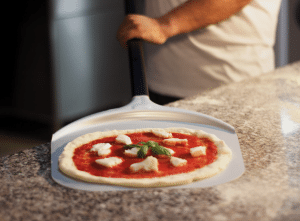
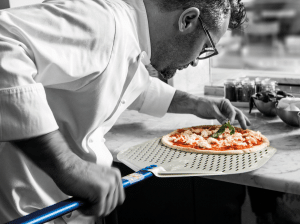
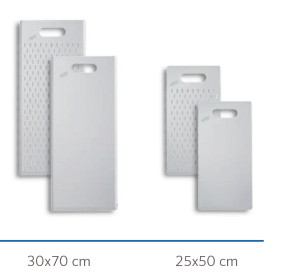
2. Perforated launch peel
Launch the pizza while reducing excess flour going into the oven.
Perforated peels have become increasingly popular because the holes allow excess flour or semolina to fall
That’s particularly useful when cooking at very high temperatures, where loose flour can burn on the oven floor and affect the flavour of the pizza.
The perforations can also help steam escape when handling a cooked pizza, helping to preserve a crisp base.
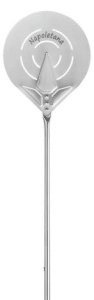
3. Turning peel
To get underneath part of the pizza and rotate it without taking the pizza out of the oven.
That’s particularly useful when cooking Neapolitan-style pizza at very high temperatures, where the pizza may only be in the oven for a minute or so.
Keeping the pizza on the hot cooking surface while turning it also helps maintain the heat of the bake.
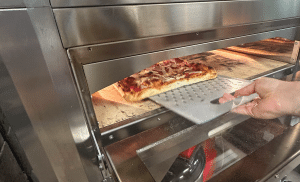
4. Retrieval peel
Get the finished pizza safely out of the oven.
Once the pizza is cooked, you need to get it off the oven floor and onto a board or serving surface.
A thin, appropriately sized metal peel can slide underneath the pizza and lift it without damaging the crust.
For some pizza makers, the same peel used to launch the pizza can also be used for retrieval. For others, keeping the preparation peel separate from the hot retrieval tools makes the workflow easier.
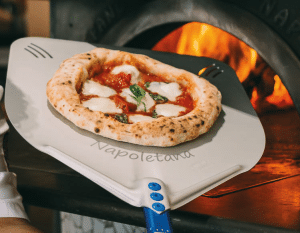
5. Serving peel
Transfer the finished pizza and serve it.
A serving peel is less about getting the pizza into the oven and more about what happens afterwards.
Depending on the setup, a wooden or presentation-style peel can double as a serving board, allowing the pizza to go directly from oven to table.
This can be particularly useful in restaurants where presentation is part of the experience.
So, how many pizza peels do you actually need?
For someone making the occasional pizza at home, one good all-purpose peel may be all you need.
A conventional peel can prepare, launch and retrieve a pizza, and can usually manage basic turning too.
But once you start making pizza more frequently, having a second peel makes a noticeable difference.
The professional setup
In a busy pizzeria, the question becomes less about how many peels do I need? and more about workflow
When you’re producing pizza continuously, small improvements in speed, control and consistency can add up.
Different ovens, pizza styles, pizza sizes and production volumes can all influence the ideal peel setup.
A professional pizza maker might therefore have several different peels available, with each one selected for a particular task.
And that’s the important point:
A pizza peel isn’t just an accessory. It’s a piece of production equipment.
The right peel for the right job
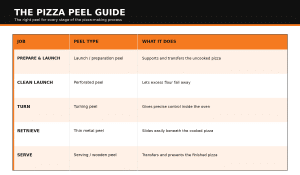
Of course, there can be overlap. A good all-purpose peel may be capable of performing several of these jobs.
But capable of doing a job isn’t necessarily the same as being the best tool for that job.
That’s why experienced pizza makers often end up with more than one peel.
The real question isn’t “How many peels do I need?”
It is....
What jobs am I asking my peel to perform?
If you’re stretching dough, launching pizza, turning pizza, retrieving pizza and serving pizza with the same tool, you’re asking one piece of equipment to do five different jobs.
For occasional pizza making, that’s perfectly reasonable.
For someone making dozens or hundreds of pizzas, separating those jobs can make the process faster, cleaner and more consistent.
The right number isn’t necessarily three, four or five.
It’s enough to give every stage of the pizza-making process the right tool.